
UHD CTLE GUIDE TO COURSE LEARNING OUTCOMES

Course Learning Outcomes
Course Learning Outcomes (CLOs) are statements that describe observable, measurable learning and behaviors that students will achieve upon completion of a course. Outcomes are written with a verb phrase and declare a demonstrable action within a given timeframe, such as the completion of a course or program. It is typical to find five to nine CLOs for a course, though this can vary depending on program needs. If you find that you have significantly more than 5-9 CLOs, you may consider converting some outcomes to module- or unit-level learning objectives. Learning objectives, while similar in structure, are more specific and used within course modules, weeks, or units. The same principles apply to writing outcomes and objectives.
How To Use This Page
This page will guide you through writing outcomes or objectives that are:
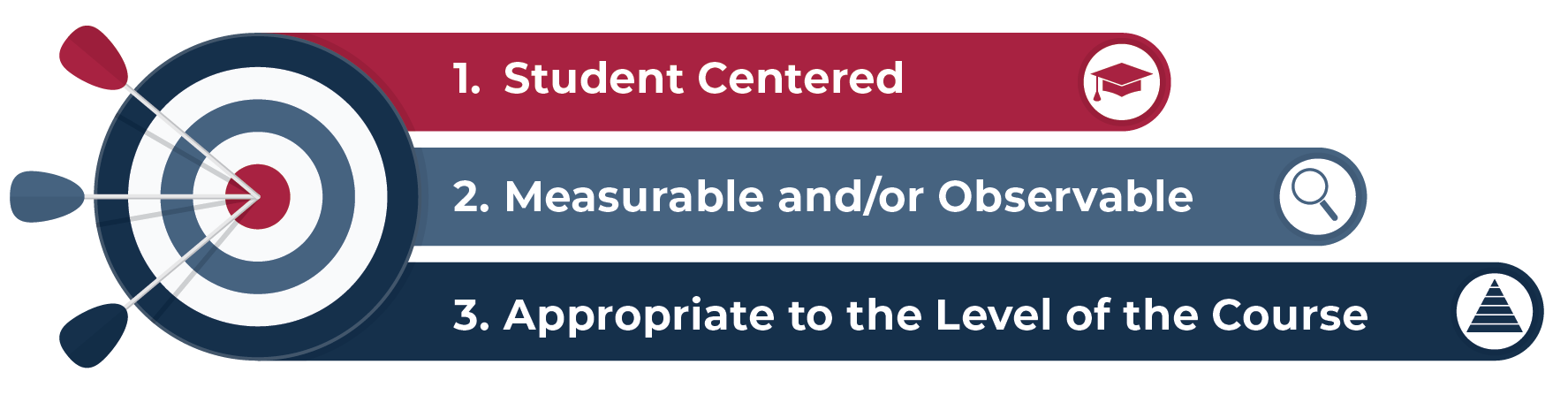
Additional Resources & References are provided at the bottom of this page.
1. Outcomes Must Be Student-Centered.
An effective learning outcome describes what the student will be accomplishing, not the instructor. What skill set should students attain by the time the course is completed? These should be stated clearly from the perspective of the student.
Helpful Prompt:
“The student will show me that they have accomplished the outcome by…”
Example:
Presenting logically persuasive arguments both orally and in writing.
2. Outcomes Must Be Observable and/or Measurable.
An effective learning outcome will be observable and/or measurable. This means that the instructor can effectively assess whether or not the student has accomplished the outcome. Consider how the instructor would witness, observe, measure, or assess the students’ accomplishment of an objective.
Helpful Prompt:
“I will observe that a student has completed the course successfully when they…”
Example:
Describe qualitative and quantitative approaches to scientific inquiry.
Using a measurable learning verb doesn’t just clarify how the instructor will assess the student, but it shifts the focus toward the student’s experience and agency. Measurable outcomes describe what students will actively do, not just what content will be covered. This empowers the student to track their progress and engage with their own learning.
Helpful Prompt:
“What verb would a student recognize as an action they could take?"
Example:
Create written elements of public relations practice.
Be Aware of Non-Measurable Learning Verbs
Student Learning Outcomes and Learning Objectives must be measurable and observable. The way that students show the accomplishment of their outcomes and objectives should be explicit. These learning verbs are either vague, un-observable, and/or non-measurable. Avoid using them when you write your learning objectives.
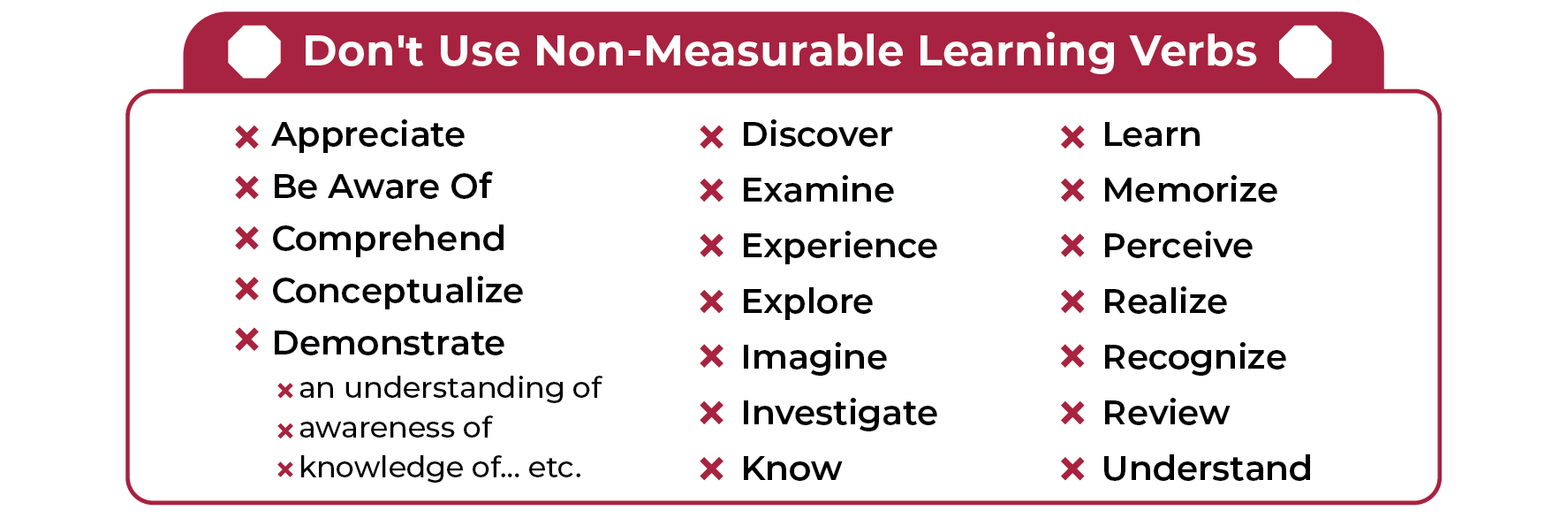
Download The CTLE's List Of Non-Measurable Learning Verbs (PDF)
3. Outcomes Must Be Appropriate.
Course outcomes should include a learning action or verb that students will accomplish by the end of the course. These verbs are often selected from Bloom’s Taxonomy, though there are other models such as the Structure of the Observed Learning Outcome (SOLO) and Taxonomy of Significant Learning. Appropriate learning verbs for each subject area, and the level of achievement expected for a student in that subject area, are best determined by a subject-matter expert. Courses may start with objectives that are in the lower-order thinking levels, and progress by the end of the course. Lower-division courses may include outcomes that build to higher cognitive levels. Upper-division courses may begin with outcomes at lower cognitive levels.
Bloom’s Taxonomy
One valuable tool for creating measurable learning outcomes is Bloom's Taxonomy, a hierarchical model that categorizes cognitive skills into levels of complexity.
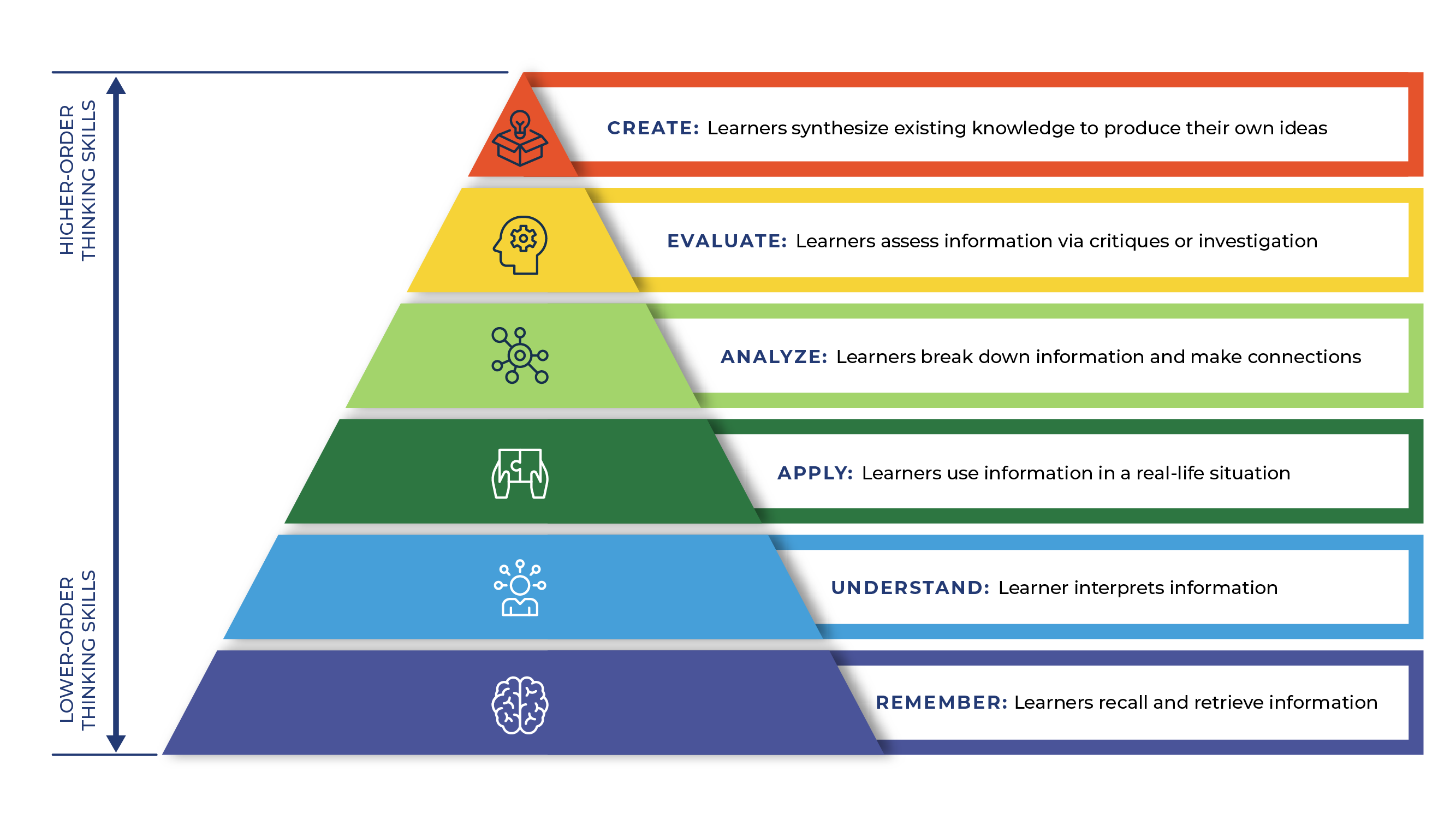
Table of Bloom’s Cognitive Domains
Steps To Writing A Course Learning Outcome (CLO)
- Start with the CLO stem Use a standard phrase that anchors the outcome in observable student achievement.
Example: “Upon successful completion of this course, the student will be able to…” - Choose a measurable verb Select a verb that reflects the cognitive level of learning expected.
Example: Create - Specify the learning to be measured Clearly state what the student will know or be able to do.
Example: written elements - Add discipline-specific context Ground the outcome in your field by describing how or where the learning will be
applied.
Example: of public relations practice.
Final Result: Upon successful completion of this course, the student will be able to create written elements of public relations practice.
Download The UHD CTLE Writing Course Outcomes Handout (PDF)
Additional Resources
Quality Matters
The UHD CTLE supports all UHD faculty in advancing their professional development through the QM workshop program. Visit the OLC/QM Workshops Page to apply for the opportunity to take up to two workshops per year and earn a stipend. The following Quality Matters workshops include topics related to outcomes, objectives, and alignment.
- Creating Course Alignment Maps
Participants in this workshop explore the concept of alignment, where key course components work together to help learners achieve desired outcomes. In this workshop, you’ll create and share an alignment map for one module, identify gaps, and strengthen alignment using the QM Higher Education Rubric. - Connecting Learning Objectives and Assessments
The “Connecting Learning Objectives and Assessments” workshop reviews course- and module-level learning objectives while using alignment to ensure that assessments are varied and support the achievement of the learning objectives. Participants apply these concepts to developing and/or reviewing their own course objectives and assessments. The content is based on General Standards 2 and 3 of the Quality Matters Rubric. This workshop may help you meet the Specific Review Standards in General Standards 2 and 3.
Tools
- ASU Learning Objectives Builder
Try using the ASU Online Objectives Builder to write measurable course outcomes and learning objectives.
ASU Learning Objectives Builder
- UHD CTLE List of Non-Measurable Learning Verbs Handout
This handout identifies vague, unobservable, and non-measurable learning verbs that should be avoided when writing clear and measurable student learning outcomes and objectives.
Download the list of non-measurable learning verbs (PDF)
- UHD CTLE Writing Course Learning Outcomes Handout
This handout provides guidance and a table of stems and prompts to assist in composing course learning outcomes (CLOs).
Download The UHD CTLE Writing Course Outcomes Handout (PDF)
Contact Us!
Need additional assistance? The CTLE is here to support your next steps. Our instructional design team offers personalized consultations to help you refine outcomes, align assessments, and implement evidence-based strategies tailored to your course. Click the button below to request a consultation. We look forward to collaborating with you in advancing student success at UHD.
Submit an Instructional Design Support Request
References
Anderson, L. W., & Krathwohl, D. (2001). A taxonomy for learning, teaching, and assessing: A revision of Bloom’s Taxonomy of Educational Objectives. Pearson.
Biggs, J., & Collis, K. (1981). Evaluating the quality of learning : the SOLO taxonomy (structure of the observed learning outcome). Academic Press.
Bilon, E. (2019). Using Bloom’s taxonomy to write effective learning objectives : the ABCDs of writing learning objectives : a basic guide. Edmund Bilon.
Fink, L. D. (2013). Creating significant learning experiences : an integrated approach to designing college courses. Jossey-Bass.
Harden, R. M. (2002). Learning outcomes and instructional objectives: is there a difference? Medical Teacher, 24(2), 151–155. https://doi.org/10.1080/0142159022020687
Quality Matters. (2020). Specific Review Standards from the QM Higher Education Rubric, Sixth Edition General Standards Points Specific Review Standards. https://www.qualitymatters.org/sites/default/files/PDFs/StandardsfromtheQMHigherEducationRubric.pdf
Simunich, B., Gregg, A., & Ralston-Berg, P. (2024). High-Impact Design for Online Courses. Taylor & Francis.
University Of Guelph. (2025). Writing, Revising and Refining Course Learning Outcomes. Uoguelph.ca. https://otl.uoguelph.ca/curricular-evaluation-assessment/learning-outcomes