
IT Governance
UHD's approach to governance for Information Technology is based on the concept that broad participation and guidance throughout the university community, combined with strategic alignment to university priorities, enhances the university's potential to achieve effective, efficient and strategic use of technology in support of its mission and goals.
Numerous individuals, groups and committees provide input to Information Technology planning and make recommendations for IT support, services, and projects. This input is channeled through one of the IT governance groups described below (Academic Technology Committee, Administrative Technology Services Group/PeopleSoft Leadership & Oversight Group), one of several university governance bodies with IT membership (Center for Teaching and Learning Excellence Advisory Board, Safety Committee, Student Governance Committee, Institutional Compliance and Risk Management Committee, and the University Planning and Budget Development Committee), or to the Senior Leadership IT Governance Council.
The Senior Leadership IT Governance Council meets annually or as needed to review IT strategy and project priority and includes Senior leadership (VPs) including the Senior Vice President for Academic Affairs, and the Vice President for Administration and Finance, and the Associate Vice President for Information Technology and CIO. This group serves as the overall leadership governance body and ultimately defines the directions and priorities for Information Technology endeavors at UHD.
The planning of IT Resources is guided by the university's strategic plan and the Information Technology Strategic Plan. The IT Strategic Plan is reviewed regularly with key stakeholders and university leadership to ensure proper alignment with the University Strategic Plan and the University's mission and goals.
Governance issues are also addressed directly in several of the Information Systems policy documents:
- PS 08.A.01: Review of Information Technology Resources Requests
- PS 08.A.02: Information Technology Policies, Procedures, Standards, and Plans
- PS 08.A.03: Academic Technology Committee
- PS 08.A.05: Academic Computing Services
The primary Information Technology-specific governance groups in addition to the Senior Leadership IT Governance Council are described below:
Academic Technology Committee
The Academic Technology Committee (ATC) is a standing, shared governance, committee with representatives from each college and includes student membership as well as staff from the library and key technology support areas. The committee acts as an advisory committee to the Provost and the Chief Information Officer with regard to academic technology matters and provides recommendations for academic computing endeavors to help the university maintain and deliver effective technology in support of teaching and learning. The committee's recommendations are incorporated in the technology planning process. ATC also partners with Information Technology in the coordination of academic technology events and showcases such as the annual Technology Learning Conference.
An example of successful findings and recommendations that have come from the Academic Technology Committee includes review, recommendation, and incorporation of the recommendations for improving classroom technology.
Administrative Technology Services (ATS) Governance Group
ATS Project Intake and Governance Chart
The Administrative Technology Services (ATS) Governance group offers a forum for engaging the user community in defining and evaluating application development needs for projects that require IT resource support. The group is led by a user representative, who coordinates the meetings and engages the group in ongoing dialogue to discuss project progress and priorities as needed and also informs the ATS group about upcoming projects identified by the University, the University of Houston System, the State of Texas or the Federal Government.
Through this group, members of the user community bring forth development and programming requests for information systems such as PeopleSoft, and engage in a process to review and prioritize the project requests and discuss project status for development projects in progress. The review process includes business process impact along with cost (resource)/benefit (service impact) analysis and an assessment of impact to other areas. While the assumption is that the user community has already reviewed available functionality in the existing systems or considered a business process change to handle the need prior to requesting any modification or any new development, IT project staff offers the opportunity to provide in-house or external expertise to determine if the request can be met without system modification or development. If it is determined that the request requires system modification, projects selected for development are placed on a priority list and are available to the IT administrative systems leadership for resource assignment. However, the CIO also regularly engages university leadership in reviewing the major project priority list and makes adjustments as needed.
Budget Planning Committee
This committee is charged with advising the President regarding the university's budget. The membership of the PBDC includes the Vice Presidents, one Dean, one Department Chair, the President of the Faculty Council and an additional member of the Faculty Council Executive Committee, the President of the Staff Council, The President of the Student Government Association, one faculty member from each college, and any others whom the President believes would be useful additions.
Requests require units to include explanations of how the new budget initiatives requested will contribute to the achievement of UHD's strategic goals. Approved technology projects by the University Planning committee are identified as “Priority and Approved” projects for IT.
Extended Cabinet
The President’s Extended Cabinet is composed of senior leadership, including the President, Vice Presidents, Deans, university faculty, student councils, and key unit heads from across the university, including the CIO. This group convenes monthly to review significant projects and address key issues. During these meetings, the CIO provides updates on major IT initiatives as needed and seeks confirmation of direction from the President and senior leadership, ensuring transparency and alignment with University's strategic priorities.
President's Cabinet
At UHD, IT reports to the Vice President for Administration and Finance (CFO), who is a member of the President’s Cabinet, which meets weekly. The CIO meets with the CFO biweekly to provide updates on major IT projects. The CFO, in turn, updates the Cabinet on these initiatives and confirms strategic direction as needed. The CFO also communicates any new priorities approved by the President’s Cabinet to the CIO. All Cabinet-approved technology priorities are considered high-priority IT projects.
Information Security
Information Security is centralized under UHS IT Security with a dotted line reporting relationship to UHD's CIO. Regular meetings with the assigned ISO and with the UHS CISO are held to discuss information security needs and issues.
IT Project Board
IT project lists and status are available to view in the IT Project Room and the IT Project Management Office Dashboard.
UHD Information Technology Planning & Governance
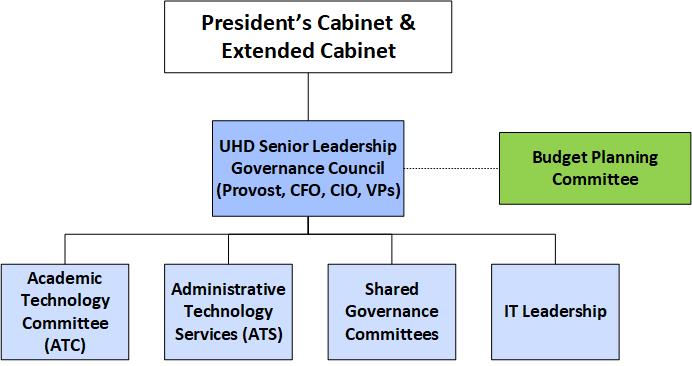
IT Governance Organization Chart:
UHD Senior Leadership Governance Council (top level)
University Planning Committee (2nd level)
Academic Technology Committe (ATC) (2nd level)
Administrative Technology Services (ATS) (2nd level)
Shared Governance Committees (2nd level)
IT Leadership (2nd level)