
JED Campus

| Visit JED Foundation | Visit JED Campus |
By becoming a member of the JED Campus program, a school demonstrates a commitment to the emotional well-being of its students. JED Campus schools embark on a multi-year strategic collaboration that not only assesses and enhances the work that is already being done but helps create positive, lasting, systemic change in the campus community.
JED Campus is an initiative of The Jed Foundation, a national nonprofit that exists to protect the emotional health of our country’s 40 million high school and college students and reduce the risks of substance abuse and suicide. To learn more visit jedcampus.org.
JED Committee
- Dr. Daniel Maxwell, Interim Vice President, Student Success and Student Life (Chair)
- Naomi Berger-Perez, Director, Student Counseling Services
- Dr. Divya Bhati, Associate Vice President, Institutional Effectiveness, Strategic Planning and Assessment
- Dr. Toi Durham, Director, Bachelor of Science in Nursing (RN to BSN program)
- Dr. Kira Gatewood, Assistant Vice President for Student Life and Dean of Students
- Kassidy Giles, Benefits and Compensation Specialist, Human Resources
- Debra McGaughey, Assistant Vice President, University Relations
- Dr. Judith Quander, Associate Vice President for Faculty Affairs and Development
- Dr. Katrina Rufino, Professor, Social Sciences
JED Approach
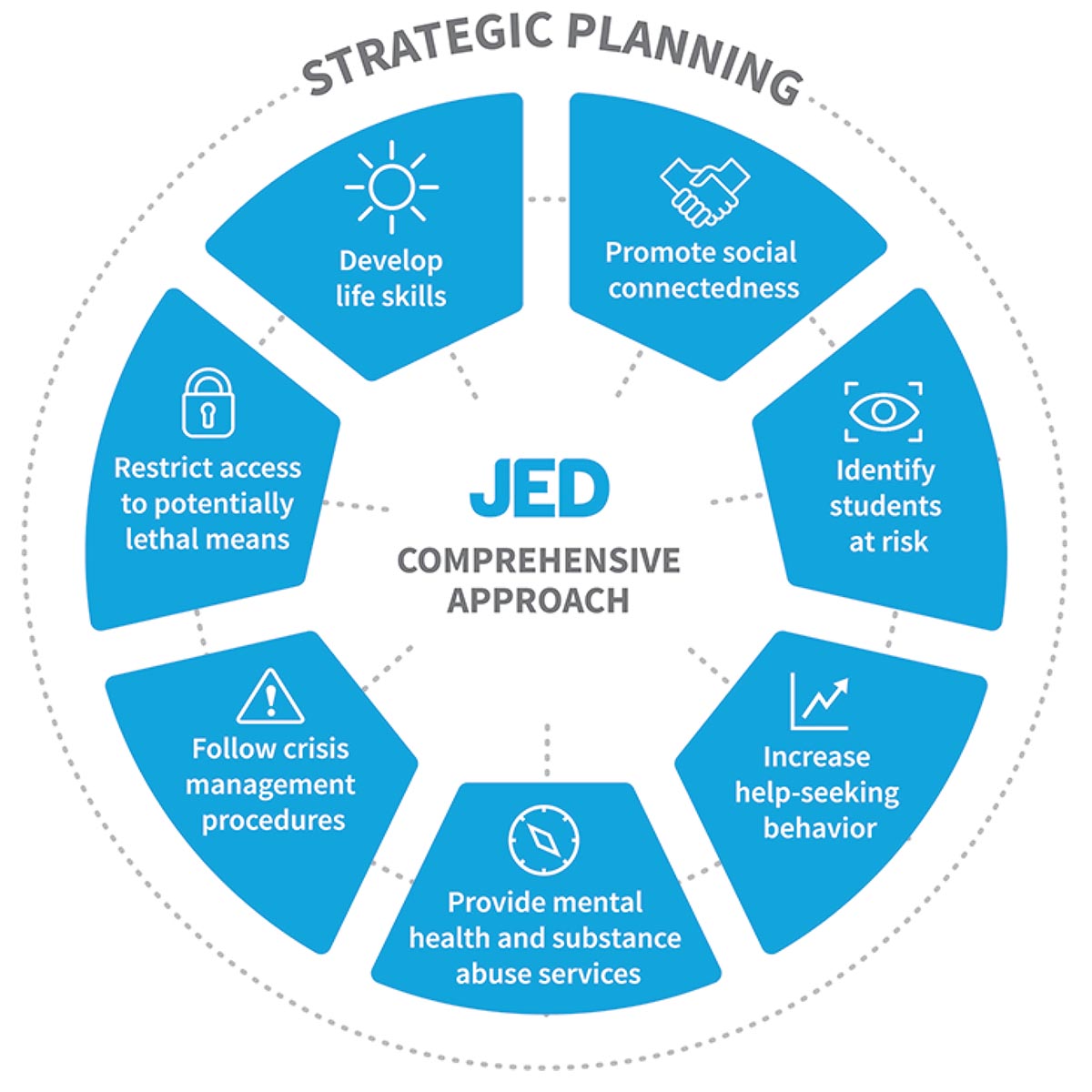
Strategic Planning
Objective: Ensure students have adequate and comprehensive health insurance coverage.
Objective: Teach students the skills necessary to cope with the stresses of college life, make wise lifestyle choices, and be academically successful.
Objective: Implement sustainable programs that offer students the opportunity to build connections with others in their community.
Objective: Ensure incoming students with mental health and substance abuse histories are supported in their transition to college.
Objective: Promote help seeking behavior through destigmatization efforts and increased access to resource information.
Objective: Ensure students have adequate and comprehensive health insurance coverage.
Resources
As we continue to cultivate a campus that prioritizes well-being, we encourage you to use the tool below to assess your mental health through a free, quick, and confidential screening. In addition to the screening tool, we encourage you to explore the resources provided by the JED website for continued support and learning:
| Mental Health America: Self Screening Tool | JED Mental Health Resource Center | JED News, Videos, Podcast, and Webinars |
| The GatorCare Tool Kit, also known as the ‘Blue Folder,’ provides a simple and accessible way for the University of Houston-Downtown community to report student safety concerns, behavioral issues, complaints, or potential policy violations. Reports are reviewed by the Gator Care Team, who respond with care, resources, and support. |  |
Student Success Initiatives
 |
The Healthy Minds Network is one of the nation’s premier research organizations contributing to adolescent and young adult mental health. HMN is dedicated to improving the mental and emotional well-being of young people through innovative, multidisciplinary scholarship. HMN spans coast to coast with our principal investigators at the University of California-Los Angeles, the University of Michigan, Wayne State University, and Boston University. Our network proudly serves as a resource for post-secondary education administrators, students, researchers, clinicians, policy-makers, and the greater public. |
|
As part of our Student Success initiatives, mental health services are highly prioritized. We are grateful for the donation of a bench for suicide prevention awareness by Josh’s Benches. This bench serves as a visible reminder that support is always within reach and encourages our campus community to pause, reflect, and check in on one another. It stands as a symbol of hope, connection, and our ongoing commitment to fostering a safe, supportive environment where students feel seen, heard, and valued. As we continue to cultivate a campus that prioritizes well-being, we encourage you to use the tool below to assess your mental health through a free, quick, and confidential screening. |
 |
|
|
The Jed Foundation (JED) is a nonprofit that protects emotional health and prevents suicide for our nation’s teens and young adults, giving them the skills and support they need to thrive today and tomorrow. Visit JED Youtube to learn more. |