
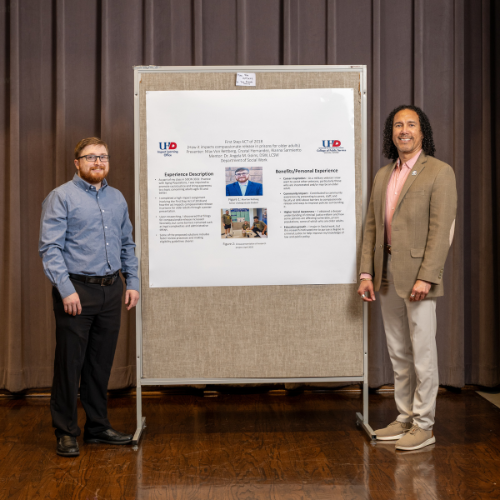
UHD senior Max Von Rettberg graduates this August with a bachelor’s degree in Social Work and a clear goal in mind. This fall, he is pursuing a Master of Social Work at the University of Houston, and, upon completion of his MSW, he plans on working with Veterans Affairs to assist other veterans like himself. Von Rettberg served in the U.S. Air Force for six years before studying at Lone Star College and transferring to UHD.
As he finishes his studies at UHD, Von Rettberg can look back on exceptional learning experiences, especially his service-learning project on older adults as part of a class taught by Angela Goins, DSW, Assistant Professor and Director of the Service, Teaching, Aging, and Research (STAR) Lab.
For his project, he researched how the First Step Act of 2018 affects Compassionate Release, which allows incarcerated individuals to request early release when extraordinary and compelling circumstances are present, such as terminal illness, old age, or severe family circumstances. Before the act, inmates could only get approved for Compassionate Release through the Bureau of Prisons, but the First Step Act now gives them the opportunity to petition a judge for release.
“I learned that although some barriers remain in the Compassionate Release process, such as legal complexities and administrative delays, the First Step Act has led to an increase in filings and approvals,” Von Rettberg said.
According to data published by the federal Bureau of Prisons (BOP), "44,673 people were released from BOP facilities under the First Step Act from 2020 to January 2024" (Bhati, 2024). As a result, more elderly and terminally ill individuals were safely reunited with their families. Bhati also states that the "recidivism rate for all people released under the First Step Act is 9.7%, which is considerably lower than the 44.8% recidivism rate for all people released from BOP facilities in 2019” (2024).
Von Rettberg’s impressive research was highlighted alongside that of other UHD students as part of last spring’s Impact Learning Showcase. “High-impact experiences play a vital role in student success by helping students develop essential skills such as communication, critical thinking, and teamwork,” said Poonam Gulati Sahotra, Ph.D., Executive Director of Impact Learning. “These experiences prepare students in both their academic pursuits and future careers.”
From Granfen DeJesus’s “My Japan Adventure: What I Saw, Learned, and Loved” to Maximilliano Perez’s “Exploring Cancer Biology and Connections to the Wider Scope of Biology,” the Showcase highlighted exceptional undergraduate research, service learning, internships, capstones, and study abroad experiences, often changing the trajectory of students’ academic journeys and beyond.