
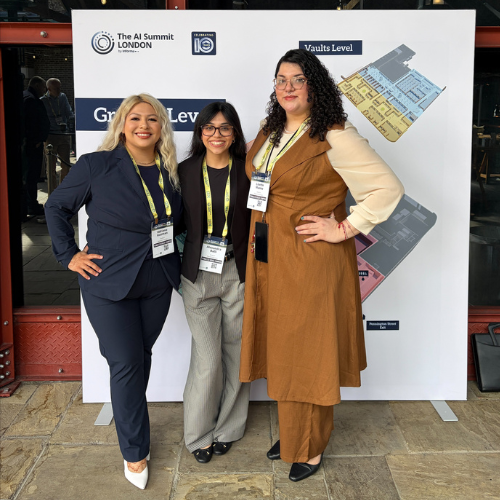
The two-day AI Summit London, part of the AI Summit Series, brought together people from around the world to discuss the latest developments in AI. Attending as a part of INT 3350 Application of Artificial Intelligence in Business in June was one of the most eye-opening experiences of my time at University of Houston-Downtown. I carried home more than just notes and business cards; I returned with a broader understanding of leadership, a greater appreciation for global perspectives, and a renewed sense of optimism about the future.
Before the trip, I expected to feel nervous and out of place—I was in a foreign land among industry leaders, entrepreneurs, and technology experts. But I found myself walking into the summit with a sense of confidence I didn’t know I had up until that point.
Preparing for the Trip and Beyond
Preparing for the summit played a major role in this. Before traveling, the professors running the Application of Artificial Intelligence study abroad course— Finance, Information Systems, Economics, and Risk Management Assistant Professor Ray Aria and Associate Professor Dr. Shohreh Hashemi—encouraged us to develop elevator pitches and finetune our résumés. The goal of the class itself was to expose students to various tech -hubs in Europe. It also included a visit to VivaTech, a similar conference in Paris that was also attended by President Emmanuel Macron. As the group traveled around, Drs. Aria and Hashemi led us through discussions about how to translate technical AI concepts into language that resonates with business and policy audiences, since most of the people we'd meet were not engineers.
Between the coursework and my spring internship, I learned firsthand how much AI implementation depends on data privacy and access controls, which gave me a more grounded perspective walking into a summit where everyone else seemed dazzled by AI's potential.
Rubbing Elbows with Tech Leaders
Thanks to all of this, I was able to throw myself into networking and asking questions of the people I engaged with. One conversation in particular stayed with me. I was talking with a woman for a while before I realized she was the CEO of a startup building an app to help international university students transition smoothly into a new country. She asked me a question that felt sincerely curious. As we kept talking, she ended up inviting me to be part of a video interview for her company, where I answered the question “What makes you happy right now?” Being part of that felt like a small but real exchange. Thanks to my time as a Ted Bauer scholar, I had already become comfortable with networking, but this interaction left me feeling invigorated—we both walked away with something, but neither of us was chasing anything monetary.
Another aspect of the summit that stood out was the opportunity to interact with people from different countries and cultures. Speaking with attendees from the United Kingdom and across Europe exposed me to perspectives that were different from those I encounter in the U.S. Many discussions focused on regulations and ethical concerns surrounding AI. I noticed that participants often emphasized protecting critical thinking skills and ensuring that technology serves society responsibly. These conversations encouraged me to reflect and consider the long-term impact of technological advancement.
Overall, the experience felt surreal, as if I was stepping into the future and seeing firsthand how artificial intelligence is shaping the world. However, unlike what I had imagined, the event was not focused on coding robots or technical demonstrations. Instead, many of the conversations centered on leadership, accountability, and the responsibility that comes with developing and using AI. Listening to experts discuss these topics made me realize that AI is not just about technology, it is about people and the decisions they make.
Reflecting on this Experience
My biggest takeaway from the AI Summit was that AI should not be viewed as something to fear. While there are legitimate concerns about its effects on education, employment, and society, there are also tremendous opportunities. AI has the potential to improve healthcare, expand educational access, and drive innovation in countless industries. The challenge is ensuring that people guide development responsibly.
Since returning, this experience changed how I approach my internships this summer. I learned to pause and self-reflect. As college students, we're constantly chasing the same finish lines: graduating faster, landing the better job, being the best in the room. But watching how the most accomplished people at the summit carried themselves taught me something different: These people were often the ones most willing to step back, sit with feedback, and ask for help instead of pretending they had it all figured out. I realized how efficient and important critical thinking and leadership really are, and I was able to apply both throughout my internships this summer. The higher you move up, the more those skills carry weight.
Ultimately, the AI Summit showed me that while technology may transform the world, it is ultimately people who will determine the direction of that change.